

Project guide
Patch a Popcorn Ceiling with Homax: Test, Prep, Spray
A leak stain or an old fixture hole leaves a flat scar in a bumpy ceiling. Find out what the ceiling is made of before any tool touches it, then rebuild the texture from below with a vertical-spray can.
By the editors of Homax Repair Guide · Published October 3, 2026
Popcorn ceilings dent easily and do not clean well. A roof leak leaves a brown ring, a swapped light fixture leaves a bare hole, and a ladder carried through a hallway knocks loose a handful of chips. Each of these can be fixed from a stepladder with a can of popcorn texture, a little joint compound and some patience with the spray tip.
The slower part is the question you answer first. Federal safety agencies write about sprayed-on decorative or acoustic material on ceilings, and older versions of it, along with the patching compounds and textured paints of the same era, could contain asbestos. You cannot tell by looking. In an older home the first step is a test by a professional, and the scraper waits for the result.
What you need
Tools
- Stepladder
- Plastic sheeting and painter's tape
- Spray bottle of water
- Putty knife or small drywall knife
- Dust mask and safety glasses
- Extension pole, if you scrape more than a small spot
- Sheet of cardboard for test sprays
Materials
- Homax Easy Patch Popcorn Ceiling Texture
- Homax Professional Match Popcorn Ceiling Texture
- Homax Popcorn Ceiling Texture, Aerosol
- Homax Pro Grade Popcorn Ceiling Texture
- Homax Acoustic Ceiling Texture Touch-Up Kit
- Homax Wall and Ceiling Texture Touch-Up Kit
- Homax Popcorn Ceiling Texture Scraper
- Homax Perforated Aluminum Ceiling Patch, 6 x 6 in
- Joint compound for holes
- Stain-blocking primer for water marks
Step by step (7)
Step 1
Get the ceiling tested
- If your home is older, or you do not know when the ceiling went up, treat the texture as if it contains asbestos until a test says otherwise. EPA notes that you usually cannot tell by looking.
- Hire a trained and accredited asbestos professional to take the sample. EPA advises against sampling the material yourself.
- While you wait for results, leave the ceiling alone. Material in good condition that nobody disturbs is not likely to release fibers.
Pro tip: Ask when the ceiling was last painted, too. A coat put on before 1978 may contain lead, which brings its own set of precautions.
Step 2
Size up the damage
- A stain with the texture still in place needs primer and a light spray, not scraping.
- A hole needs a backing and a flat fill before any texture goes on. CPSC warns that sprayed-on material that is loose, crumbling or water-damaged may release fibers, so leave a sagging or soaked area to a professional.
- Measure the bare spot. The popcorn cans that print a coverage figure, and both touch-up kits, list 2 to 4 square feet, so a bigger scar needs more than one can.
Step 3
Clear loose texture, but only after a clean result
- Once the test shows no asbestos, mist the damaged area with water and scrape back only the loose or stained chips around the repair.
- The Homax Popcorn Ceiling Texture Scraper has a 12-inch blade, a threaded handle for an extension pole and a clip for a plastic bag, so the chips fall into the bag instead of onto the floor. The pole and the bag are not included.
- Its blade is designed to keep from gouging the drywall, but press lightly anyway. Every gouge becomes another patch.
Pro tip: Spread plastic on the floor even with the bag in place. Some texture always misses it.
Step 4
Fill holes and seal stains
- Back a hole with a perforated aluminum ceiling patch, 6 by 6 inches, and fill over it with joint compound until it sits flat with the drywall around it.
- Sand the fill as little as you can. NIOSH notes that joint compound dust irritates the eyes, nose, throat and airways.
- Seal a water stain with a stain-blocking primer before any texture goes over it. The Popcorn Ceiling Texture label asks you to finish every ceiling repair before you spray.
Pro tip: If the ceiling was painted before 1978, put the sanding sponge away. EPA advises fixing small damaged areas under 6 square feet without sanding.
Step 5
Match the can to your chips
- Look closely at the old texture with a flashlight held flat to the ceiling, and note how big the chips are and how far apart they sit.
- For a small spot, the Easy Patch can sprays a water-based popcorn texture and covers up to 4 square feet.
- For a ceiling a contractor sprayed when the house was built, the Professional Match can contains real polystyrene chips and is designed to match originally applied commercial popcorn texture.
- For a ceiling built from a different aggregate, Pro Grade Popcorn says it replicates polystyrene, perlite or other popcorn aggregates.
Pro tip: Spray a test burst onto cardboard held overhead and compare it with the ceiling in daylight before you commit to the repair.
Step 6
Spray straight up
- Shake the can as its label directs. The standard Popcorn Ceiling Texture can asks for one full minute of shaking after the ball starts to rattle, and more shaking while you work.
- These cans use a vertical spray tip. Hold the can upright about 18 to 24 inches below the ceiling, as that same label specifies, and build the texture in short bursts.
- That can sprays best between 68 and 72 degrees Fahrenheit, so warm a cold room before you start.
Pro tip: Work from the center of the patch outward and stop just short of the old edge. A thin halo of new chips blends better than a heavy ring.
Step 7
Touch up and put the can away
- For a ding the size of a coin, a touch-up kit is easier to control than a can. The Acoustic Ceiling Texture Touch-Up Kit pairs a reusable hand sprayer with premixed texture made with real polystyrene chips, enough for up to 2 square feet.
- Let the patch dry for the time on the label before you paint near it or take the plastic down.
- To store a partly used Easy Patch can, its label says to remove the straw, turn the can upside down and spray until the texture clears.
Why the test comes before the scraper
CPSC lists patching and joint compounds for walls and ceilings, and textured paints, among household materials that may contain asbestos, and says their use was banned in 1977. It names sprayed-on decorative or acoustic material on ceilings and walls as another source, and warns that sanding, scraping or drilling these surfaces may release fibers.
EPA gives the same advice from another angle. You usually cannot tell whether a material contains asbestos by looking at it. If you plan a repair or the material is already damaged, have it inspected, and leave sampling to a trained and accredited professional. Do not sweep, vacuum, sand, scrape or drill material that might contain asbestos.
A result showing no asbestos frees you to scrape, sand and spray. A positive result does not mean the ceiling must come down. CPSC advises leaving material in good condition alone, and treats sealing it in place, called encapsulation, as work for a trained specialist too.
Painted ceilings in homes built before 1978
Plenty of popcorn ceilings have been painted at least once. EPA notes that the federal government banned lead-based paint for homes in 1978, so a house built earlier is more likely to have it. Renovation that disturbs old paint can create large amounts of lead dust. Young children face the greatest risk.
For a small ceiling repair that means wet methods and no power sander. EPA suggests fixing damaged areas under 6 square feet as soon as you can and without sanding, and it advises against steel wool and abrasive cleaners on painted surfaces when you clean up afterward.

When the patch is bigger than a can
Aerosol cans and touch-up kits are made for spots. The coverage printed on them runs from 2 to 4 square feet, and a scar much larger than that will use up several cans and still look uneven at the edges.
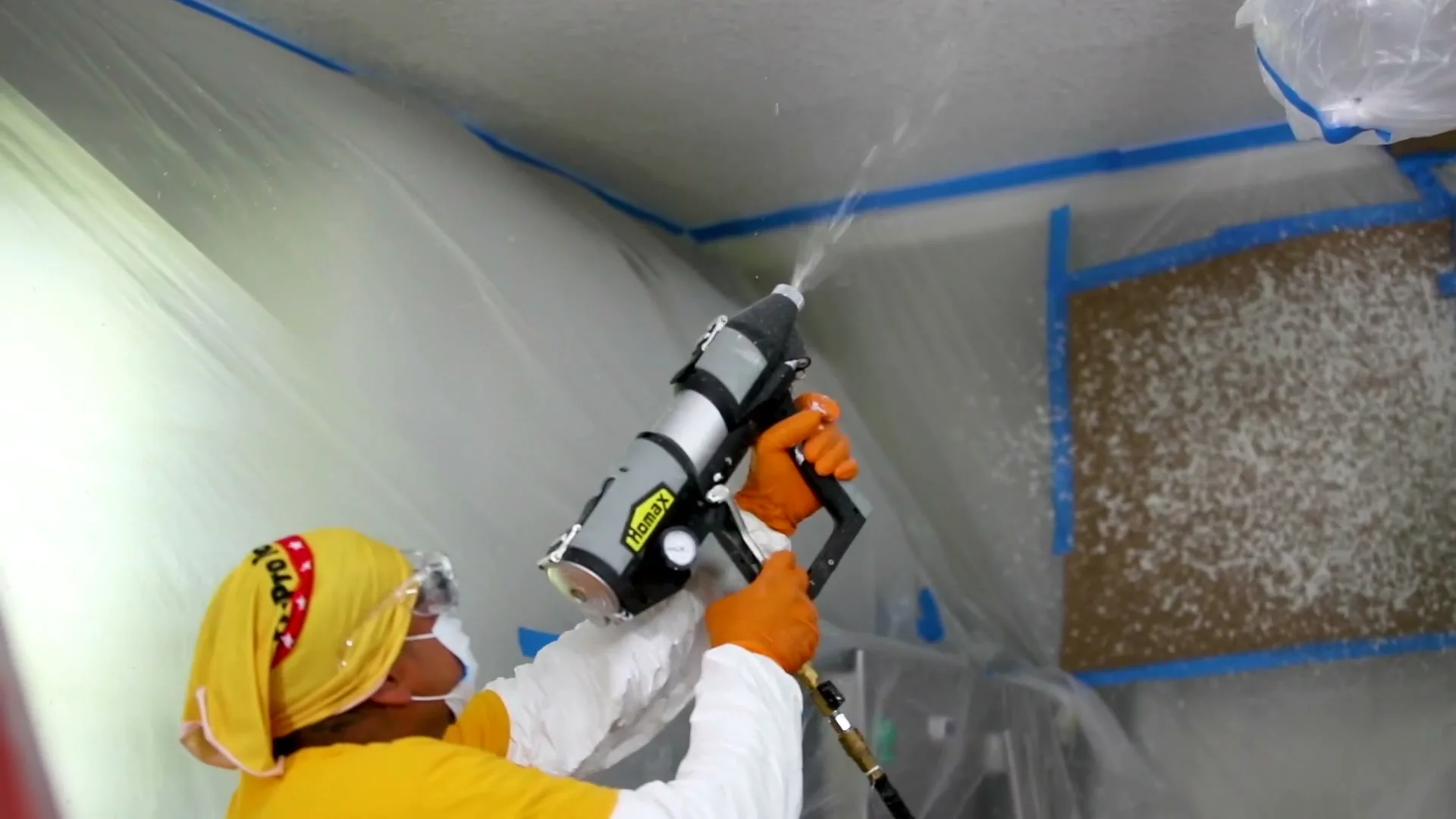
For a whole room, the Homax Professional Texture Gun with its 5-liter hopper sprays popcorn acoustic ceiling texture from dry mix or premixed material. It runs from a compressor of 2 hp or larger, rated at a minimum of 7 cfm at 25 psi.
Taking the whole ceiling down is a bigger decision again. The Homax scraper is built for that job, and its maker claims a 10 by 10 foot ceiling in 30 minutes or less. That speed only matters for texture that has already tested free of asbestos.
Storing and discarding the cans
Popcorn texture comes in aerosol cans, and the U.S. Fire Administration warns that aerosol cans put in the trash can explode or start a fire. It also advises never storing anything that can cause a fire in the sun or near an open flame or heat source. Keep partly used cans in their original packaging, in a cool cupboard out of reach of children and pets, and ask your local waste agency how it collects them.
| Product | Size | Coverage on the label | What the label says it matches |
|---|---|---|---|
| Easy Patch Popcorn Ceiling Texture | 14 oz aerosol | Up to 4 sq ft | Popcorn ceiling texture, water-based |
| Professional Match Popcorn Ceiling Texture | 16 oz aerosol | Up to 2 sq ft | Originally applied commercial popcorn, real polystyrene chips |
| Popcorn Ceiling Texture, 4070 | 16 oz aerosol | See the can | Polystyrene chip ceiling textures |
| Pro Grade Popcorn Ceiling Texture | 14 oz aerosol | See the can | Polystyrene, perlite or other popcorn aggregates |
| Acoustic Ceiling Texture Touch-Up Kit | Hand sprayer with premixed texture | Up to 2 sq ft | Popcorn texture, real polystyrene chips |
| Wall and Ceiling Texture Touch-Up Kit | Hand sprayer with dry mixes | Up to 2 sq ft of ceiling texture | Orange peel, splatter, knockdown and popcorn |
The scraper, the cans and both touch-up kits named here are part of the Homax lineup.